
[stag_toggle style=”normal” title=”Piece details” state=”closed”]VAS CHRISTIAN DÉSIRÉ
1/4 of the 20th century
Colored glass in mass; free-blown; layered; interleaved decoration; molded; etched with acids and wheel; hand-painted with enamel and colloidal gold[/stag_toggle]
Georges Walter describes in 1702 in his family chronicle how his ancestors, who had a glassworks in Soucht, obtained permission from the Duke of Lorraine, Leopold I, to move their factory to a place called "Meiserbach" due to the exhaustion of wood fuel. The founders of the new glassworks were Jean-Martin, Jean-Nicolas and Etienne Walter, Sébastien Burgun and Martin Stenger. After concluding a 30-year lease with the Duke of Lorraine, they set up their furnaces in Meisenthal, on the site of an old, destroyed glassworks.
Around 1792, after the French Revolution, the Meisenthal glassworks, which had been rented until then, was purchased by the founders' heirs. In 1800, it had 18 partners and 56 workers, producing glasses, watch glasses and windows, and in 1823 it changed its name to "Meisenthal Glassworks".
Starting in 1824, the Meisenthal factory was called "Burgun, Schwerer et Cie", and in 1834 it presented for the first time, at the regional exhibition in Metz, crystal glasses that stood out "for the perfection of the shape and the precision of the cross-cuts". In 1855, the Meisenthal glassworks was praised at the Universal Exhibition in Paris for its large vessels and for its high-quality and pure opalines.
In the 1860s, Nicolas Mathieu Burgun, who was in charge of the factory, concluded, for the first time, a series of deals with the glass, ceramic and furniture manufacturer Charles Reinemer Gallé, from Nancy. 1867 is the year in which his son, Emile Gallé, will begin his apprenticeship at Meisenthal. The collaboration between the two factories will be increasingly close, until the start of the Franco-Prussian War, in 1870-1871, when it temporarily ceases.
CHRISTIAN DÉSIRÉ (1846 – 1907) ran the decoration workshop of the "Burgun, Schwerer et Cie" company in Meisenthal, which became the most important glassworks in German Lorraine after 1885. Emile Gallé, linked to Meisenthal since his youth and a friend of Antoine Burgun and Christian Désiré, concluded with them, in 1886, a "secret contract", which stipulated the terms of a collaboration between his workshops in Nancy and those in Meisenthal. Emile Gallé's help was essential for the preservation of the valuable Lorraine decorators, since the latter provided them with permanent work. The artistic quality claimed by Gallé influenced the production of the Meisenthal workshops, a fact confirmed by the excellent and original pieces made under the brand name "Verrerie d'art de Lorraine" in these years. Christian Désiré, who had an independent status within the glassworks, acceded, upon signing the contract with Emile Gallé, to the position of partner of the Lorraine workshops.
In 1889, Christian Désiré's works shined alongside those of Gallé at the Universal Exhibition in Paris. This success of both creators was beneficial for their collaboration, through the large number of orders that overwhelmed Gallé, some of which were executed by the workshops run by Christian Désiré.
Five years later, the collaboration contract was cancelled, due to a fall in the market and a reduction in the number of orders. As a result, after 1894, Meisenthal produced certain models designed for Nancy, decorated with almost identical motifs, but signed "Vallérysthal". This was probably the solution proposed by Gallé and applied with his knowledge, so that the workshops led by Christian Désiré could find an outlet in an increasingly limited market. During this period, Meisenthal pieces were marketed under the name "Verrerie d'art de Lorraine Burgun, Schwerer et Cie", inscribed in the thistle medallion, characteristic of Lorraine, engraved with a stiletto, which allows them to be dated between 1895 and 1903.
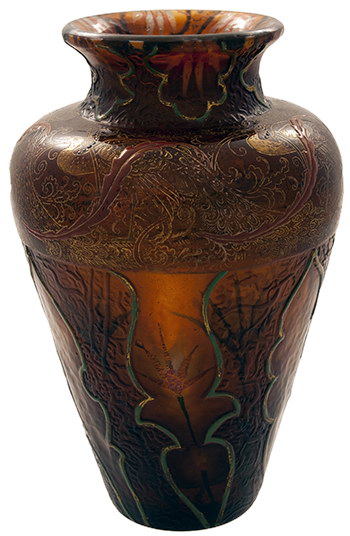
VESSEL
CHRISTIAN DÉSIRÉ
1/4 of the 20th century
Colored glass in the mass; free-blown; layered; interleaved decoration; pressed glass paste; hand-painted with enamel and colloidal gold
In 1901, "Burgun, Schwerer et Cie" was transformed into a joint-stock company. Antoine Burgun, considered too Francophile and too close to his friends in Nancy, was replaced by Emile Wanner, owner of six shares of the capital, as was Christian Désiré. The new management limited artistic production, which led Christian Désiré to move his studio into his own house. After 1903, his son Armand joined him, and the studio's name became "Christian Désiré and Son". This is how the pieces sent to exhibitions will be registered.
Christian Désiré's refined, symbolist-inspired style is easily recognizable. His original process of creating enamel decorations, sandwiched between a bright-colored background and a colorless outer layer, on which the wheel then carves the gradients and gives relief, animating the motif between the layers, makes Christian Désiré's works true aesthetic wonders of the Art Nouveau style.
Christian Désiré's art is inseparable from that of Emile Gallé. Christian Désiré was among the first artists co-opted by Emile Gallé when he founded the School of Nancy in 1901, a distinction that proves the high regard given to his personality and art by the master of Art Nouveau and remained untouched after the end of a collaboration of over thirty years. The artist, who remained in the shadow of Emile Gallé's overwhelming personality, died almost unknown in Meisenthal, less than three years after the man who had been his friend from his youth until the last years of his life.
The Peleş National Museum owns three Christian Désiré pieces; two of them seem to belong to the same family: they are small, pear-shaped, wavy-lipped, green vases decorated with yellow chrysanthemums on a frosted background. A closer look reveals that in one of the vases the chrysanthemums are painted on the frosted base layer by acid etching and covered with a colorless surface layer. The stems and centers of the flowers are painted on the outer layer, and the decoration is completed by mechanical engraving and gold underlining.